
Yes, live chat typically increases conversions, and the range is wide: industry data puts the lift anywhere from 10% to 70% depending on execution. But speed decides most of the outcome. Skip the guesswork and run an audit that ranks fixes by impact before you touch your chat widget.
TL;DR:
- Response time is critical, with delays of over 90 seconds significantly reducing conversion rates and most abandonment occurring within three minutes.
- High-quality chat implementation, including deep integration and quick replies, explains nearly half of the variation in conversion success across studies.
- Triggering chat based on behavior, like exit intent or scroll depth, is more effective than page load prompts in driving engagement and conversions.
- Hybrid models combining bot automation with human follow-up outperform single-channel setups, especially for high-value or complex sales.
- Regular audits focusing on response times, trigger placement, and CRM integration can quickly identify high-impact improvements to increase chat-driven conversions.
Table of Contents
- Key Statistics and Benchmarks for Live Chat Conversion
- How Does Live Chat Actually Drive Conversions?
- What Are the Best Practices to Increase Live Chat Conversion?
- How Do You Measure Live Chat Conversion and Which KPIs Matter?
- What Mistakes Are Hurting Your Live Chat Conversion Rate?
- How Do You Audit and Prioritize Live Chat Fixes?
- Real Examples of Live Chat Conversion in Action
- Live Chat vs. Email, Phone, and Social Media: Which Converts Better?
- When Should You Use Human Chat Instead of Automation?
- Get a Ranked List of Your Chat and Conversion Fixes
- Sources
- FAQ
Key Statistics and Benchmarks for Live Chat Conversion
The spread in reported results comes down to one thing: how well the chat is built, not whether chat itself works. A 1,247-business study from Conferbot found implementation quality alone explains about 41% of the variance in outcomes, with integration depth and response speed pulling most of the remaining weight.
Statistic Callout: Visitors who engage with chat convert at several times the rate of visitors who don't, and a single fast agent reply can raise conversion likelihood by around 50%, according to aggregated industry figures. More replies compound that effect.
Response time benchmarks matter just as much as the chat's presence:
- Every 30 seconds of first-response delay costs roughly 7% of conversion probability.
- Conversion decay accelerates sharply once median response time crosses 90 seconds.
- Most abandonment happens by the 3-minute mark, according to the same benchmark data.
- Sample sizes vary widely across studies, so treat these as directional ranges, not fixed rules for your traffic.
How Does Live Chat Actually Drive Conversions?
Chat works because it removes friction at the exact moment a buyer is deciding. A shopper staring at a pricing page with one unanswered question is a shopper about to leave. Live chat closes that gap before it turns into a lost sale.
The mechanism splits into a few distinct jobs:
- Information delivery: Chat answers pricing, shipping, and compatibility questions that would otherwise send someone to a search engine, and often to a competitor.
- Persuasion and empathy: Human agents handle complex or high-value deals better than automation, especially where trust is the real barrier.
- Speed and coverage: Bots handle simple, repetitive questions instantly and around the clock, catching leads a human team would miss overnight.
- Intent recovery: A chat prompt at cart abandonment or during demo booking can rescue a purchase that a popup or email never would.
Hybrid setups, bot first, human follow-up, tend to outperform single-channel models on qualified leads and satisfaction, largely because they cover more hours without sacrificing the human touch when it matters.
What Are the Best Practices to Increase Live Chat Conversion?
Most of the conversion lift sits in five or six decisions, not in the chat platform's feature list. Here's the order to tackle them in:
- Trigger on behavior, not page load. Exit intent, scroll depth past 70%, and time-on-pricing-page are far better signals than firing a popup the instant someone lands on your site.
- Set a response-time target and defend it. Aim for a sub-30-second blended first response time. If your team can't hit that consistently, deploy an AI first-responder to hold the conversation until a human joins.
- Design the conversation, not just the widget. Five to six qualifying questions delivered conversationally, each offering something back (a price estimate, a relevant resource), outperform a static contact form as part of effective content marketing services. Research on chat flows shows diminishing returns past six questions, so stop there.
- Connect chat to your CRM, calendar, and analytics. A chat that doesn't create a CRM record or attribute a booked demo is a chat you can't measure, and can't improve.
- Staff for peak load, not the daily average. Median response time can look fine while your busiest hour quietly loses half its leads to a queue.
- Change one variable at a time. Test trigger logic, then opening message copy, then routing rules, separately, so you know what actually moved the number.
Pro Tip: Before you touch conversation copy, check your response-time distribution by hour. A great median FRT with a terrible 6 p.m. spike is the single most common blind spot in chat performance reviews.
How Do You Measure Live Chat Conversion and Which KPIs Matter?
Two formulas cover most of what you need. Engagement rate equals chats started divided by total visitors. Chat conversion rate equals purchasers who used chat divided by total visitors, while chat-engaged conversion rate narrows that to purchasers divided by everyone who actually chatted, a cleaner measure of chat's own effectiveness.
| Metric | Formula | Why it matters |
|---|---|---|
| Engagement rate | Chats ÷ visitors | Shows chat's reach across traffic |
| Chat-engaged conversion | Purchasers from chat ÷ chatters | Isolates chat's true lift |
| First response time (FRT) | Time to first agent/bot reply | Directly tied to conversion decay |
| Abandonment rate | Chats left unanswered ÷ chats started | Flags staffing or routing gaps |
| Cost per lead | Chat program cost ÷ qualified leads | Ties chat spend to pipeline value |
To estimate lost conversions from slow response, apply the roughly 7% decay per 30 seconds figure against your current median FRT. Tag chat sessions with UTMs and page context, and auto-create CRM records on every qualified chat so demo bookings and closed deals trace back to the conversation that started them.
What Mistakes Are Hurting Your Live Chat Conversion Rate?
Most conversion problems trace back to a handful of repeatable mistakes, and the Conferbot study flags these as the most common causes of underperformance:
- Immediate, aggressive popups that fire before a visitor has scrolled, which spikes bounce rate instead of engagement.
- Dead-end flows that collect an email or a question and then go nowhere, with no handoff and no follow-up SLA.
- Overpromising bot capability, letting a scripted bot pretend to be a human until it fails a basic question and torches trust.
- Ignoring peak-hour distribution, staffing to your average FRT while your busiest hour bleeds leads nobody sees.
Pro Tip: Label your bot as a bot from the first message. Visitors forgive a bot that says so upfront far more readily than one that gets caught pretending.
How Do You Audit and Prioritize Live Chat Fixes?
Run a quick pass on five things before you rebuild anything: CTA clarity, pricing visibility, chat placement on mobile, your FRT distribution, and whether chat sessions actually tag into your CRM. Then rank whatever you find by impact against effort, and start with the cheap, high-impact items first.
- Fix response time first, usually with an AI first-responder, since it's the fastest lever with the clearest payoff.
- Move your trigger to the pricing or checkout page if it isn't already there.
- Confirm every qualified chat creates a CRM record automatically.
- Re-test mobile placement, since a chat bubble covering the checkout button is a common, invisible leak.
Combining AI diagnostics with human review, the approach Save Your App takes, tends to surface exactly this kind of ranked list rather than a generic best-practices summary.
| Fix | Typical effort | Typical impact |
|---|---|---|
| AI first-responder for FRT | Low | High |
| Trigger repositioning | Low | Medium to high |
| CRM handoff tagging | Medium | High |
| Mobile placement fix | Low | Medium |
Give it 7 to 14 days: implement your top one or two fixes, track the same KPIs you started with, and iterate from there.
Real Examples of Live Chat Conversion in Action
The clearest pattern across documented cases is that speed and conversation design beat platform choice every time. Businesses that moved from a passive contact form to a proactive, triggered chat widget consistently reported gains in qualified leads, not just raw chat volume, because the qualifying questions did the filtering work a form can't.
One recurring case type: ecommerce sites that added exit-intent triggered chat on cart pages saw cart recovery improve measurably, since a shopper with one unresolved shipping or sizing question is often one answer away from completing checkout. B2B software sites that added a bot-first, human-follow-up model on pricing pages reported more booked demos, largely because the bot captured after-hours visitors a sales team would otherwise never see.
The common thread in the stronger examples isn't the software vendor. It's that each company treated chat as a conversion system, response time targets, qualifying flow, CRM handoff, rather than a support widget bolted onto the site. The weaker cases almost always skipped the handoff step: a lead got captured in chat and then sat untouched for days because no SLA existed to route it. Hybrid setups that combined bot speed with human closing power outperformed single-channel chat on both qualified lead volume and satisfaction in controlled comparisons, which lines up with what most practitioners find once they start measuring chat separately from other channels.

Live Chat vs. Email, Phone, and Social Media: Which Converts Better?
Live chat wins on speed and moment-of-decision capture, which is exactly what the other channels struggle with. Email is asynchronous by design, useful for nurturing, weak for catching someone mid-purchase who has a single blocking question right now. Phone support converts well for complex or high-value deals but scales poorly and can't run unattended, and hold times create the same abandonment risk that slow chat responses do. Social media is strong for brand engagement and public reputation management, but it's a poor fit for private purchase questions and rarely ties cleanly into a CRM-attributed conversion.

The real advantage of chat is that it sits directly on the page where the buying decision happens, at the moment friction appears. A visitor comparing pricing tiers doesn't want to open an email client or dial a number. They want an answer in the next thirty seconds, and if chat delivers, it captures intent that email and phone structurally cannot reach in time.
That doesn't make chat a replacement for the other channels. Phone still closes bigger, more sensitive deals better than any chat window. Email still nurtures leads who aren't ready to buy today. Social media still builds the audience chat later converts. The smartest setups route each channel to the job it does best and use chat as the fast, low-friction front door, then hand off to phone or email once a deal needs more depth than a chat window can hold.
When Should You Use Human Chat Instead of Automation?
Complex, high-value, or emotionally sensitive sales need a human on the other end. Empathy and judgment still beat scripted logic there. Bots earn their place on speed and after-hours coverage, catching leads a human team would simply never see at 2 a.m.
Hybrid stacks consistently beat single-channel setups in the data reviewed here, mainly because availability and integration matter more than which technology answers first. Build for coverage first, then layer in the human judgment where deal complexity actually demands it.
— William
Get a Ranked List of Your Chat and Conversion Fixes
Most teams don't need more chat features. They need to know which three things on their site are actually costing them sales, and in what order to fix them. Saveyourapp runs your page through AI-driven diagnostics and pairs it with human beta tester reviews across seven audit layers, including conversion and onboarding, then hands back a ranked fix list instead of a generic report.
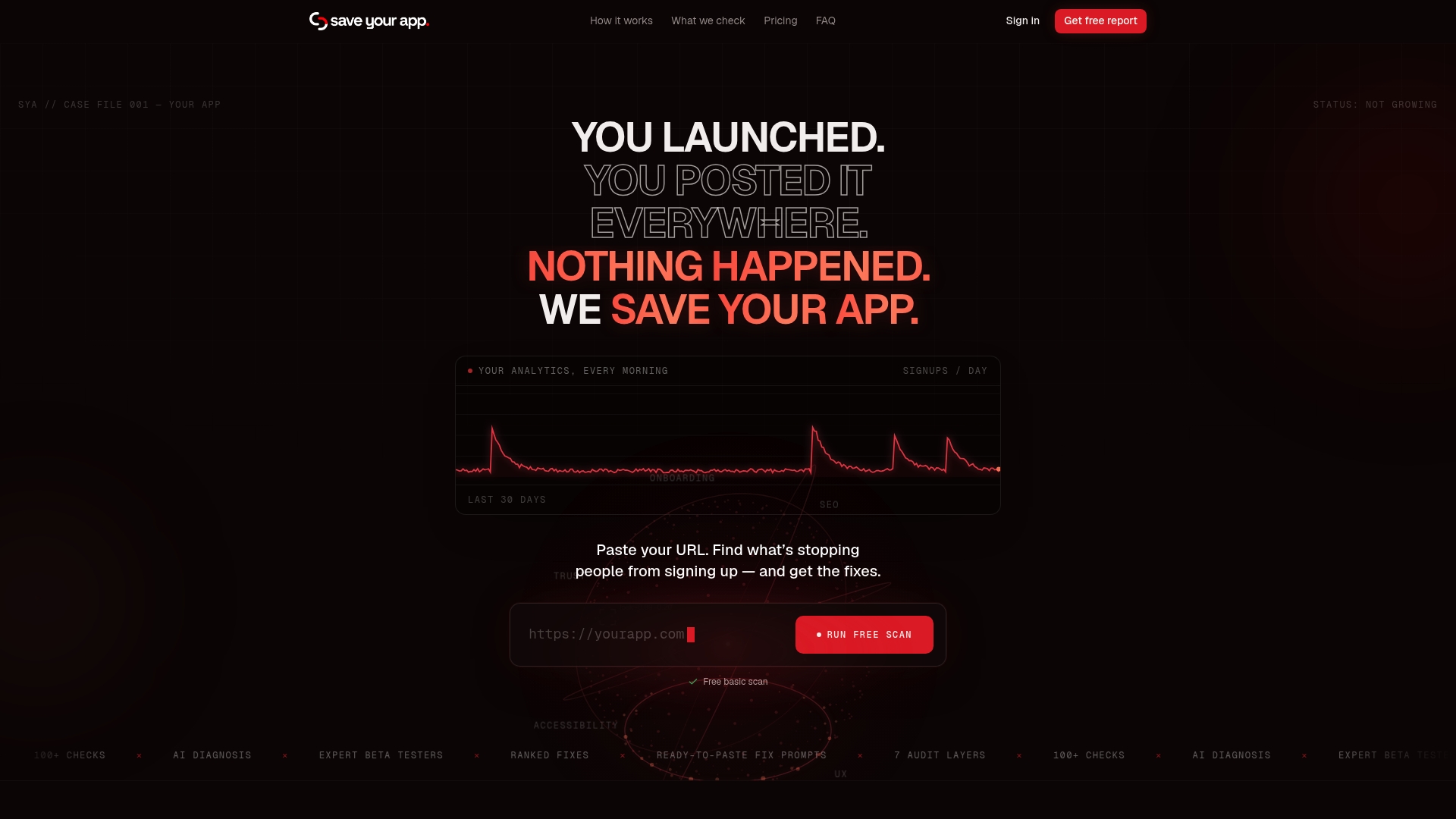
A free scan gets you a starting point and a PDF summary of what's actually blocking signups on your site. If you want repeated audits and full access to the ranked dashboard, the Solo plan runs $49 per month, and Founder runs $129 per month. Either way, you walk away with a prioritized list you can start acting on today instead of another audit that just describes the problem.
Sources
- Do Chatbots Increase Sales? 1,247-Business Study — Conferbot
- Live Chat Response Time Impact: The 2026 Conversion Data — Venturesathi
- How Much Does Live Chat Increase Conversions? — Campaign Monitor
FAQ
How Much Does Live Chat Cost?
Costs vary widely by provider and feature set, from free basic tools to enterprise platforms with per-agent pricing. If you're auditing your site's conversion setup rather than pricing a chat tool, Saveyourapp offers a free scan, with paid plans at $49 or $129 per month for deeper, repeated audits.
Is It Conversion or Conversation That Chat Actually Improves?
It's both, but conversation quality is what drives the conversion number. A fast, well-designed conversation with the right qualifying questions converts far better than a slow or generic one, which is why response time and flow design matter more than the chat platform itself.
What Is the Best Website for Live Chat?
There's no single best platform. The right fit depends on your traffic volume, staffing, and whether you need bot-first coverage or human-led sales conversations. What matters more than the tool is implementation quality, which one study found explains about 41% of the variance in whether chat actually lifts conversions.
How Do I Access Live Chat on a Website?
Most live chat tools appear as a widget in the bottom corner of a webpage, triggered either immediately or after a behavior like scrolling or dwelling on a pricing page. If you don't see one, the site may not have chat enabled, or it may only appear on specific pages like checkout or support.
Does Live Chat Really Increase Conversions Compared to Not Having It?
Yes, in most documented cases, with reported lifts ranging from roughly 10% to 70% depending on how well it's built and staffed. The gains come mostly from fast response times and well-designed qualifying conversations, not from the presence of a chat widget alone.