

An AI conversion audit is an automated, evidence-first review that scans a website or app flow, flags conversion barriers, and returns ranked, testable fixes. The primary payoff is speed: teams get prioritized opportunities and rough impact estimates in minutes instead of weeks. Use an automated audit for regular triage, and reserve a full moderated study for high-stakes or ambiguous user decisions.
TL;DR:
- AI conversion audits are best used for quick triage, focusing on high-impact flows like checkout, where improvements can significantly boost conversion rates.
- Prioritize fixing issues in critical paths such as messaging clarity, trust signals, form design, and mobile responsiveness to maximize impact.
- Use industry benchmarks, especially Baymard's data on cart abandonment, to estimate potential gains from flow-specific improvements like checkout redesigns.
- Validate AI recommendations with your analytics and user sessions before implementing, as false positives are common in low-priority areas.
- Combine AI pattern detection with human review for ambiguity, ensuring judgment calls and trade-offs are made by experienced teams.
Table of Contents
- Step-by-step workflow to run or commission an AI conversion audit
- What AI checks: the conversion factors and why each matters
- How scoring and prioritization work, and how to interpret them
- Measurement essentials: tying audit findings to GA4 key events
- Human plus AI: what to keep human and why Save Your App uses human reviewers
- Action-first checklist: what to do immediately after the audit
- When AI audits return the most ROI
- Save Your App: AI diagnostics plus human beta-tester reviews
- Primary sources and further reading
- Sources
- FAQ
Step-by-step workflow to run or commission an AI conversion audit
A useful AI conversion audit follows a set order. Skipping steps produces reports that look thorough but miss the friction that actually costs conversions.
- Run a quick automated scan: feed the tool your URL and let it analyze layout, copy, load speed, and basic UX factors.
- Add persona and task prompts: ask the AI to simulate a specific buyer completing a specific goal, such as "a first-time visitor trying to find pricing."
- Layer in technical scans: performance, accessibility, and basic technical SEO checks catch issues a purely visual review will miss.
- Run separate task audits for funnels: checkout, signup, and onboarding each need their own pass, not a folded-in mention inside a general homepage review.
- Synthesize everything into scores and a prioritized fix list, then export the report for engineering and design handoffs.
Checkout deserves special attention here. Baymard Institute's checkout research is built on hundreds of moderated sessions and benchmarking across hundreds of checkout steps, and it treats checkout as its own research category precisely because generic page audits miss flow-specific friction like account-creation pressure or payment trust gaps.
What a synthesized audit should hand back:
- A numeric or tiered score per page or flow.
- A ranked list of fixes, ordered by estimated impact.
- Screenshots or annotated evidence for each flagged issue.
- An exportable report your team can attach to a sprint ticket.
Pro Tip: Run the quick scan first and the persona-based prompts second. The quick scan tells you where to point the deeper, task-specific review, so you are not paying for depth on pages that do not need it.
What AI checks: the conversion factors and why each matters
AI conversion audits typically work through a consistent set of factors, each tied to a specific point of user drop-off.
- Messaging and value proposition: unclear headlines or a CTA that does not match the visitor's intent both increase bounce before a user ever reaches a form.
- Trust and credibility signals: missing security badges, absent social proof, or buried return policies raise hesitation at the exact moment a user is deciding to commit.
- Form and field design: long forms, unclear error messages, and fields that appear all at once instead of progressively tend to push users to abandon mid-task.
- Performance and Core Web Vitals: slow load times directly increase bounce and reduce engagement before content even renders.
- Mobile and responsive behavior: friction that is invisible on desktop, like a button hidden below the fold on a phone, often accounts for a large share of lost conversions on mobile traffic.
- Onboarding flow elements: unclear first-run steps and missing progressive activation cues stall new users before they experience the product's value.
Checkout is the sharpest example of why factor-level review matters. Baymard's 2025 research finds an average cart-abandonment rate of 70.19% and estimates that large ecommerce sites could see roughly a 35.26% conversion-rate increase from checkout design improvements alone. That single flow, examined closely, can outweigh a dozen smaller landing-page tweaks combined.
How scoring and prioritization work, and how to interpret them
Most AI audit tools score pages using a weighted mix of factors: messaging clarity, trust signals, technical performance, and persona-alignment checks that simulate whether a specific user type can complete a specific task. The output usually sorts into priority tiers.
- High impact: issues tied to core conversion paths, like checkout or signup, where a fix touches many users at once.
- Quick wins: low-effort changes, like button copy or field labeling, that can ship without engineering time.
- Low priority: cosmetic or edge-case issues that affect a small share of traffic.
Estimating potential lift works best when tied to a known benchmark rather than a guess. If your checkout mirrors the friction patterns Baymard documents, industry-wide, its research suggests improvements in that specific flow can produce outsized gains compared to general page edits.
AI recommendations are not automatically correct. Common false positives include flagging a form field as "too long" when the extra step actually builds trust, or scoring a page low on mobile speed when the real issue is a third-party script. Validate before shipping.
Pro Tip: Cross-check any "high impact" AI recommendation against your own analytics and, where possible, a handful of real user sessions before committing engineering time.
Measurement essentials: tying audit findings to GA4 key events
An audit is only useful if you can measure whether the fix worked, and that starts with clean event tracking. Google's GA4 guidance recommends marking important user actions as key events and building conversions from those events, replacing the older Universal Analytics goal model. Key events and UA goals count and attribute differently, which is why teams migrating between the two often see numbers that do not match.
Before you act on any audit recommendation, confirm the events tied to that flow are tagged correctly and that your key events map to actual business outcomes, not just page views. Common mismatches include duplicate tags, ecommerce schema differences between UA and GA4, and consent-mode modeling that estimates conversions rather than counting them directly, all of which Google documents as sources of discrepancy between the two platforms.
| Measurement element | What to check | Why it matters |
|---|---|---|
| Key event mapping | Each funnel step tied to a named key event | Prevents conflating vanity metrics with real conversions |
| Tag coverage | No duplicate or missing tags across pages | Avoids inflated or deflated conversion counts |
| Consent-mode modeling | Modeled vs. observed data noted separately | Explains gaps between GA4 and prior UA figures |
Turn each audit finding into a hypothesis with a named KPI, for example "shortening the signup form will raise completed-signup key events by a measurable margin within two weeks," rather than a vague note to "improve the form."
Human plus AI: what to keep human and why Save Your App uses human reviewers
AI is strong at pattern detection and fast at organizing evidence. It is weaker at judgment calls that require context: interpreting why a user hesitated, or deciding which of three plausible fixes to prioritize when they conflict. Nielsen Norman Group's guidance recommends using AI for support tasks like surfacing patterns and drafting recommendations, while keeping moderation and sense-making with human researchers, since that is where the experiential learning happens.
- Keep session moderation and follow-up questioning human.
- Keep ambiguous behavior interpretation human.
- Keep trade-off prioritization decisions human.
- Let AI handle the first pass: scanning, scoring, and drafting a fix list.
Some audit tools build on this split directly by combining AI diagnostics with human beta-tester reviews on paid plans, producing ranked fixes that reflect both automated pattern detection and human interpretation.
AI can produce useful outputs, but it cannot replace the experiential learning that comes from human-led observation and interpretation.
— William
Action-first checklist: what to do immediately after the audit
An audit report that sits in a shared drive does nothing. Move fast on a short list.
- Pick one to three prioritized fixes and turn each into a testable hypothesis.
- Design an A/B test or staged rollout with a single, named KPI per fix.
- Coordinate the handoff: a quick brief to engineering and content so nothing stalls in translation.
- Record the outcome, whether it worked or not, and feed that into the next audit cycle.
| Step | Owner | Output |
|---|---|---|
| Select fixes | Growth lead | 1 to 3 hypotheses |
| Run experiment | Product/engineering | A/B or staged rollout |
| Track result | Analytics owner | KPI change tied to key event |
| Schedule next audit | Growth lead | Recurring cadence |
When AI audits return the most ROI
Lightweight AI audits earn their keep in continuous triage: catching regressions, flagging quick wins, and keeping a backlog fed between bigger research pushes. Where the decision is genuinely ambiguous, a pricing page redesign, a checkout redesign, a new onboarding flow, moderated research earns its cost. The strongest growth programs do not choose one over the other. They let AI find the patterns fast and cheap, then send the ambiguous ones to a human for context before anything ships.
— William
Save Your App: AI diagnostics plus human beta-tester reviews
Running a DIY AI scan gets you a first pass. Save Your App adds the second pass built in: its Prism Engine™ runs seven audit layers, covering technical SEO, performance, UX and navigation, conversion, accessibility, trust and security, and onboarding, then pairs that with human beta-tester reviews before returning a ranked, prioritized fix list and a PDF report.
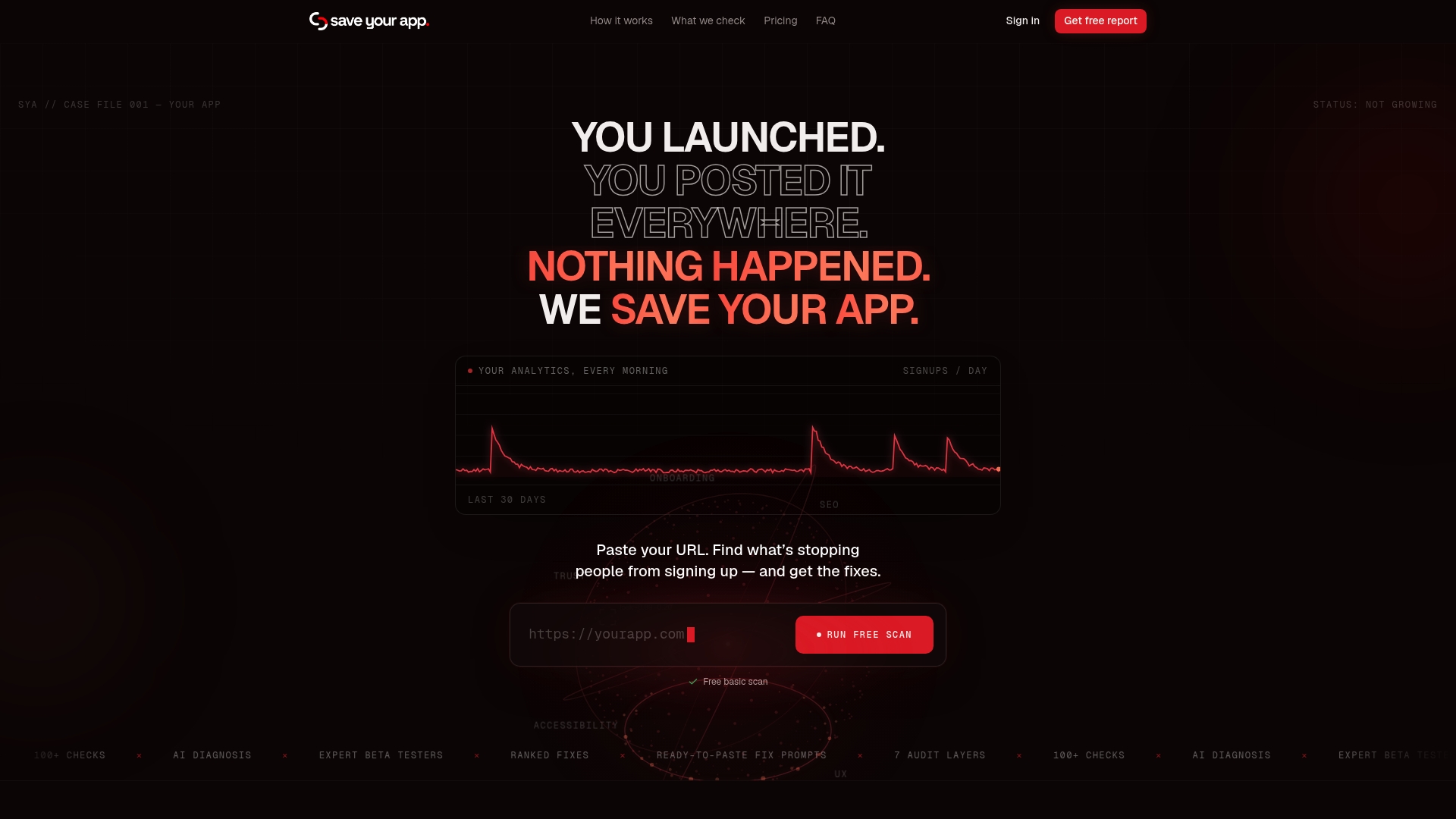
Teams running quick, recurring checks can start on the Free plan, while teams that want repeated audits and full human review should look at the Solo and Founder plans. Run a free scan or compare plans to see which tier matches your audit cadence.
Primary sources and further reading

For deeper reading: Baymard Institute's checkout research, Google's GA4 key events guidance, Nielsen Norman Group on human-led research, and Skopos Innovation's A4i on human plus AI testing.
Sources
- Current state of checkout UX — Baymard Institute
- Conversions and key events in Google Analytics 4 — Analytics Help
- Why human-led research still matters in the age of AI — Nielsen Norman Group
FAQ
Is AI going to replace conversion auditors?
No, current guidance points toward AI handling pattern detection and first-pass scanning while humans keep moderation and judgment calls. Nielsen Norman Group frames AI as a support tool for research, not a replacement for human-led interpretation.
Is a 10% conversion rate considered good?
A good conversion rate depends heavily on industry, traffic source, and funnel stage, so there is no single universal benchmark. Checkout specifically shows how much room typically exists: Baymard's research finds an average cart-abandonment rate of 70.19%, meaning even strong-looking sites often have significant headroom in that one flow.
How much do AI auditors make?
Compensation for people running or building AI-driven audit tools is not publicly listed in a single consistent source and varies by role, region, and whether the work is in-house or agency-based. This article focuses on how to run and interpret AI conversion audits rather than salary data for the people who build or use them.
Is the IRS using AI for audits?
This article covers AI-driven website conversion audits, not tax audits, and does not have sourced information on tax authority practices. For anything related to tax audits, check guidance directly from your country's tax authority.